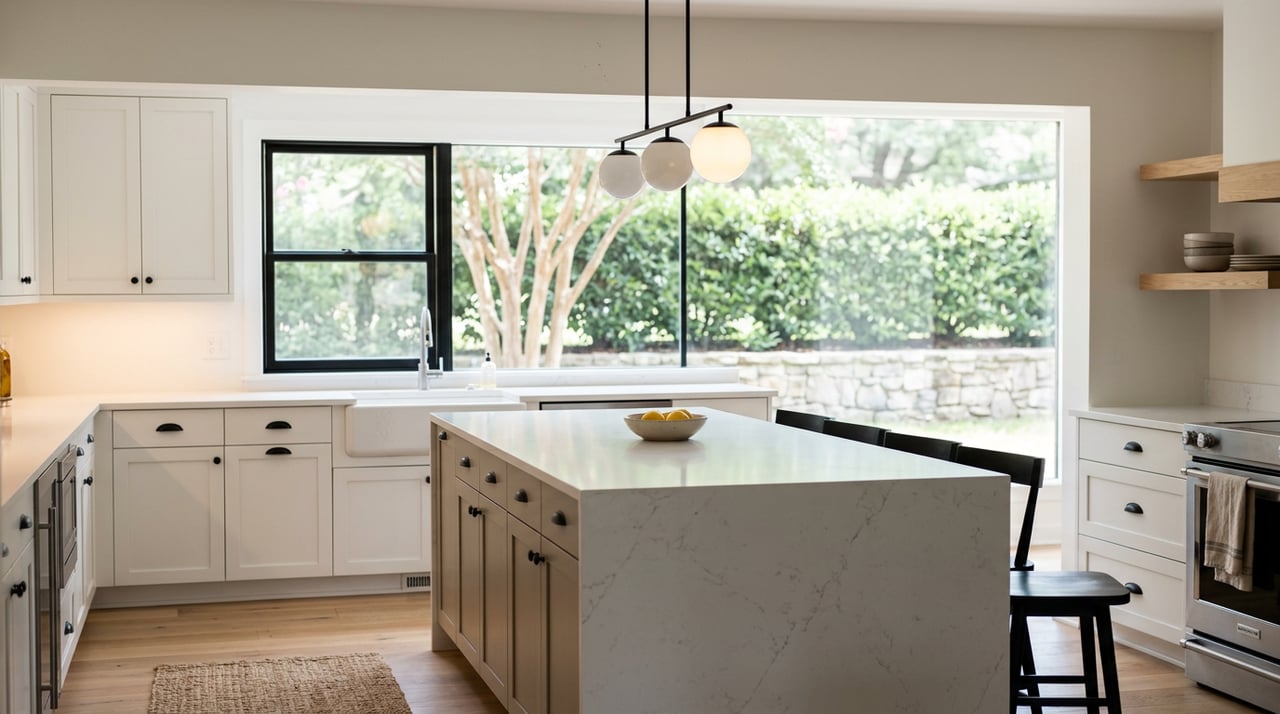
Two homes go up for sale in Moores Creek this month. Both sit inside the same small Lennar community in Madison, within easy commuting distance of Huntsville and Athens. Both are priced in the same bracket. On paper, a buyer comparing them side by side would expect the monthly payment to land in roughly the same place too.
It won't. One of these homes comes with a builder incentive tied to a specific lender. The other comes with something rarer: a loan a buyer can step into and keep, at a rate two full points below what anyone shopping fresh financing will be quoted this week. Same subdivision, same price range, two completely different costs of money. That gap is the actual story in Moores Creek right now, and it's one most buyers never think to ask about.
The rate gap hiding in plain sight
As of the last week of July 2026, Freddie Mac's Primary Mortgage Market Survey put the average 30-year fixed rate at 6.66%. A few days later, Bankrate and NerdWallet were quoting 6.79% and 6.53% on the same day, which is its own small lesson: even "the current rate" depends on whose survey you're reading and which lender fed them data that week. Nobody hands you a single number. You get a range, and the range this summer sits in the mid-to-high 6% territory.
Now compare that to a resale currently listed inside Moores Creek: a five-bedroom home with a three-car garage, an in-ground pool, and a loan a qualified buyer can assume at 4.75%.
Run the arithmetic and the gap stops being abstract. On every $100,000 financed, the difference between 4.75% and 6.65% works out to roughly $120 a month in principal and interest alone, using a standard 30-year amortization. On a hypothetical loan balance in the mid-$300,000s, a common range for a loan that's been paying down for a few years, that gap turns into something north of $400 a month, every month, for as long as the loan is outstanding. That's not a rounding error. That's a car payment, or half a year's HOA dues repeated twelve times over.
What actually shows up on each ledger
| New construction (Lennar) | Resale with an assumable VA loan | |
|---|---|---|
| Rate you're quoted | Today's market rate, roughly 6.5% to 6.9% depending on lender and day | The seller's existing rate: 4.75% |
| How the "deal" works | A builder credit toward closing costs or a rate buydown | You qualify to take over the seller's loan itself |
| What the rate applies to | The full purchase price | Only the seller's remaining loan balance |
| Community costs | $21 a month HOA, plus a 0.72% special tax rate reported for the community | Same HOA and tax structure if the resale sits in Moores Creek |
| The catch | Lose the incentive if you use your own lender | Gap financing on the difference between price and assumed balance |
New construction in Moores Creek has recently listed in the $446,000 to $622,000 range, with homes on Willet Circle and Kite Circle priced around $607,990. That's the number on the sign. It isn't the number that determines your payment, because two buyers closing on identical floor plans this month could walk away with meaningfully different loans depending on which lender they use and what strings came attached.
The strings on the new-construction incentive
Lennar's own legal disclosures spell out how the incentive works, and the language is worth reading closely before anyone assumes a builder credit is simply free money. As Lennar states in its own terms, "offer may require financing through seller's affiliate Lennar Mortgage, but use of Lennar Mortgage is not required." Read that twice. You're never forced to use the builder's lender. You just lose the credit if you don't.
That's a real tradeoff, not a trick, but it's one a lot of buyers don't run the numbers on. A closing cost credit worth several thousand dollars might still beat a lower rate from an independent lender, or it might not, depending on your loan amount, your credit profile, and how long you plan to stay in the home. The only way to know is to get a loan estimate from Lennar Mortgage and a competing estimate from an independent lender, then compare the two side by side on the same loan amount and term. The National Association of Home Builders reported in June 2026 that a majority of builders nationwide were leaning on sales incentives to move inventory, which means this same lender-tied structure is showing up far beyond Moores Creek. That makes it a fact worth checking on any new-construction contract in North Alabama this year, not just this one.
Why the assumable loan isn't automatically free money either
The 4.75% rate on that Moores Creek resale is real, but it doesn't automatically apply to the entire purchase price. An assumable VA loan lets a qualified buyer take over the seller's existing loan, at the seller's existing rate and remaining term. It does not create a new, larger loan at that old rate. If the sale price is higher than what the seller still owes, and it almost always is after a few years of payments and appreciation, the buyer has to cover that gap somehow. That's usually cash, or a second loan at whatever rate is available today for that smaller amount.
So the real comparison isn't "4.75% on the whole house" versus "6.65% on the whole house." It's a blended number: a big chunk of the loan at 4.75%, a smaller chunk of financing at today's rate to cover the gap, and a lender and the VA both having to approve the assumption before any of it closes. Done right, the blended rate still beats financing the entire purchase fresh. It just takes more paperwork and more patience than a standard mortgage application, and not every seller, lender, or timeline is set up to make that work smoothly.
What this means if you're weighing the two options
If you're comparing a new-construction contract against a resale in the same community, the price tags won't tell you which one actually costs less. Ask for the builder's loan estimate and an independent lender's estimate on the same terms before you decide whether the incentive is worth keeping the tied lender. If a resale advertises an assumable loan, ask the listing agent for the actual remaining balance and interest rate on that loan, not just the headline rate, so you can calculate the real gap you'd need to finance separately.
This is exactly the kind of financing puzzle that trips up relocating military families the most, since PCS timelines often don't leave much room to shop lenders slowly or negotiate an assumption at a leisurely pace. It's also exactly the kind of puzzle where having someone walk the math with you before you write an offer saves real money, not just time.
A few questions worth asking directly
Does assuming a VA loan mean the buyer has to be a veteran? No. Assumption is generally open to qualified buyers regardless of military status, though the loan still has to go through the standard approval process with the lender and the VA before it transfers.
Does assuming the loan reset the clock to a fresh 30 years? No. The buyer takes over the loan's remaining term and rate as they stand today, not a new 30-year loan at that old rate.
What happens to the seller's entitlement once someone else assumes their loan? This is worth a direct conversation with the seller's lender and the VA, since it can affect the seller's ability to use a VA loan again, particularly if the buyer assuming the loan isn't also a qualifying veteran.
Every one of these questions has a specific, checkable answer for a specific loan. None of them are guesses you want to make after you've already signed a contract.
If you're comparing new construction against a resale anywhere in Moores Creek, Madison, or the surrounding North Alabama communities, and you want someone to run the real math before you commit to either one, Donley Real Estate has spent years walking Navy veterans and PCS families through exactly this kind of decision. Schedule your free consultation and bring the two listings you're deciding between. We'll help you figure out which one actually costs less, not just which one looks like it does.